



At Hearn & Fleener, stucco and EIFS construction defect claims are among the most technically complex cases we handle, and among the most important. The hidden nature of stucco-related damage means that communities often do not discover the full scope of the problem until significant structural deterioration has already occurred. We specialize in uncovering these building envelope failures using forensic investigation methods that reveal what the finished surface conceals, and we build the technical and legal case that forces builders to fund comprehensive repairs. Every step of our investigation is performed at no cost to your association or property.
Colorado Stucco & EIFS Construction Defect Attorneys.
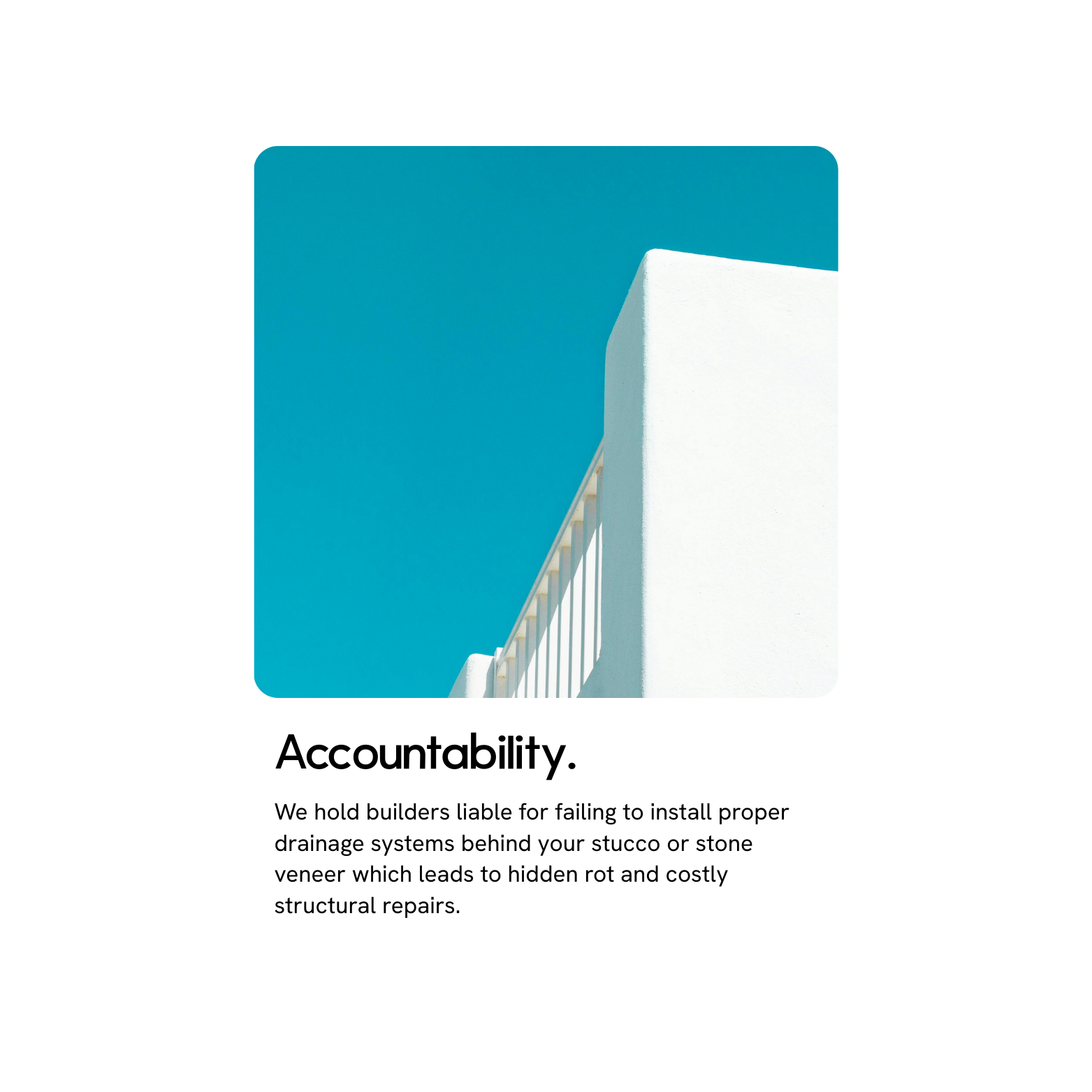



Stucco failures hide behind finished walls for years. When they finally surface, the damage is far deeper than it appears. We find it, document it, and hold builders accountable.
Stucco and stone veneer are among the most complex and highest-risk exterior finishes used in Colorado construction. While these materials provide a distinctive aesthetic, they are reservoir systems that naturally absorb moisture. When a builder fails to install a properly executed drainage plane behind the stucco finish, water becomes trapped against the wooden structural frame hidden beneath the surface. This leads to silent rot and mold growth that remains invisible for years — and by the time it is discovered, the damage has typically spread far beyond what anyone expected.

Why Colorado's Climate Makes Stucco Defects Worse.
Stucco and EIFS defects that cause slow hidden damage in mild climates become catastrophic and expensive failures in Colorado.
Here is why.


Freeze-Thaw.
Temperature extremes crack stucco and open pathways for water.
Soil Movement.
Expansive soils crack stucco from the foundation up.
Snow & Ice.
Snowmelt infiltrates every gap in a defective stucco system.

Moisture Trapping.
Missing drainage planes trap water with nowhere to go.
UV Exposure.
High altitude UV degrades sealants and surface integrity rapidly.
Hail.
Hail impacts crack stucco and breach EIFS barriers.
How Hearn & Fleener Investigates Stucco Defects.
Stucco defect claims are among the most disputed in Colorado construction defect law because the damage is hidden behind a finished surface. Builders routinely attribute cracking and moisture intrusion to normal settling, weather events, or deferred maintenance rather than installation failures. Establishing that the damage results from a systemic construction defect requires forensic methods that go far beneath the surface.
Here is exactly how we build that case.
-
Our team conducts a comprehensive forensic investigation of your stucco or EIFS system using infrared thermal imaging, moisture meters, and selective probing to map the full extent of moisture intrusion within wall assemblies. Infrared imaging identifies areas of elevated moisture behind stucco surfaces without requiring destructive investigation at every location, allowing us to develop a complete picture of the damage before any destructive testing is performed.
-
Because stucco defects cause damage that is hidden behind a finished surface, confirming the installation failures responsible for the moisture intrusion requires selective destructive investigation at strategic locations. Our forensic team carefully removes stucco samples at locations identified through thermal imaging and moisture testing to document the as-built conditions behind the surface, including the presence or absence of drainage mats, weather barriers, flashing components, and proper scratch coat depth and application.
-
Not all stucco cracking is the same, and the pattern, location, and character of cracks is one of the most important diagnostic tools in a stucco construction defect investigation. Our forensic team analyzes and documents crack patterns across the entire building elevation, identifying the difference between normal minor surface cracking and the patterned cracking caused by missing expansion joints, structural movement from expansive soils, or improper stucco mix ratios. This analysis directly supports the legal distinction between a construction defect and normal aging.
-
We pull the original building permits, approved architectural plans, stucco and EIFS manufacturer installation specifications, and any building envelope specifications in the project documents. This research establishes exactly what standard your stucco system was supposed to be built to, identifies every subcontractor responsible for the installation, and confirms whether the installed system met the applicable building code requirements at the time of construction. For EIFS systems we also review the manufacturer's specific installation requirements, which are highly detailed and which most installers do not follow correctly.
-
Our complete findings, the thermal imaging results, moisture investigation, crack pattern analysis, destructive investigation findings, and specification review, are compiled into a written report and presented in person to your Board of Directors and management company. Your board receives a complete picture of every stucco defect identified, the responsible parties, the projected repair scope and cost, and the realistic financial outcome of pursuing a claim. All of this is provided at no cost and with no obligation before your board makes any decision.
Common Stucco Defects.
Stucco & EIFS Deficiencies.
Most stucco and stone defects are the result of systemic installation errors where the builder prioritized speed over proper moisture management.Most stucco and stone defects result from systemic installation errors where the builder prioritized speed over proper moisture management. When any component of the stucco system is missing or incorrectly installed, the entire system fails and because the damage occurs behind a finished surface, it is rarely discovered before significant structural deterioration has already occurred.
Defect Types.
1
Cracking
2
Peeling
3
Moisture
4
Chipping
Installation.

The bottom edge of every stucco wall must terminate with a perforated metal weep screed that allows water absorbed by the stucco to drain out at the base of the wall. When builders bury this component in landscaping, concrete flatwork, or soil, or omit it entirely, moisture has no exit point and wicks upward into the wall framing. This single installation failure is responsible for some of the most extensive and expensive stucco-related structural damage we document in Colorado construction defect claims.
Flashing.
Where a roofline meets a stucco wall, a specialized metal diverter flashing is required to direct water into the gutter rather than behind the stucco surface. When builders omit this component or install it incorrectly, water running off the roof is funneled directly behind the stucco finish and into the wall cavity with every precipitation event. Roof-to-wall flashing failures are among the most common sources of severe hidden water damage in Colorado stucco communities.
Expansion Joints.
Colorado’s extreme temperature swings cause stucco to expand and contract. Builders often omit the necessary joints, leading to excessive cracking that allows bulk water to bypass the weather barrier.Colorado's extreme temperature swings cause stucco to expand and contract far more aggressively than in moderate climates. Building codes require expansion joints at regular intervals to accommodate this movement. When builders omit these joints, the stucco has nowhere to move except into cracking and those cracks act as direct pathways for water to bypass the weather barrier and enter the wall assembly. In Colorado communities with large stucco surfaces, missing expansion joints typically produce widespread cracking across the entire building elevation.
Transitions.
The area where stucco meets a window or door is a high-risk failure point. If the builder fails to leave a gap for sealant, the stucco will pull away and create a direct path for water intrusion.The interface between stucco and a window or door frame is one of the highest-risk failure points in any stucco system. Builders are required to leave a gap between the stucco surface and the window frame for a continuous backer rod and sealant application. When builders apply stucco directly to the window frame without this gap, the stucco bonds to the frame and pulls away as temperatures change, creating a direct water entry point at every window and door in the building. This failure is systematic, affecting every opening in the building simultaneously.
Connections.
Stone veneer and manufactured stone products require a specific installation sequence including a wire lath substrate, scratch coat, and precise mortar application depth to ensure proper bonding and moisture management. When stone veneer is installed directly to sheathing without the required substrate layers, or when mortar application is too thin or inconsistent, the veneer loses its bond over time and becomes a pathway for water infiltration behind the cladding system. The Golden case result referenced below is a direct example of how hidden stone veneer installation failures can affect entire Colorado communities.
Drainage.
Modern building standards require a rainscreen or drainage mat installed between the stucco and the house wrap to create a physical gap that allows moisture absorbed by the stucco to drain downward and escape at the weep screed. When builders skip this component, the stucco sits directly against the house wrap with no drainage path for absorbed moisture. The result is a wall system that cannot dry out, creating persistently saturated conditions that cause progressive rot in the wood framing behind the stucco surface.
Frequently Asked Questions.
1
Cost
2
Time
3
Effort
4
Liability
-
Not all cracking is equal. Minor hairline cracks from normal curing are expected. The patterns that indicate a construction defect are cracks visible from several feet away, diagonal or staircase patterns indicating structural movement, map cracking across large sections indicating missing expansion joints, and any cracking accompanied by discoloration near windows or doors indicating water intrusion. Even minor cracking in a system without a proper drainage plane can allow significant water into the wall assembly, making early professional evaluation important regardless of crack size.
-
Small hairline cracks from minor settling are not necessarily a concern on their own. However, cracks wider than a credit card, or map cracking across large sections, indicate structural stress, missing expansion joints, or improper mix ratios. These act as direct water entry points and should be professionally evaluated rather than simply sealed, because surface sealing without addressing the underlying cause allows moisture to continue entering through any crack that was missed.
-
Brown or dark staining beneath window corners is a reliable visual indicator of failed window-to-stucco flashing. Water leaking behind the stucco absorbs tannins from rotting wood sheathing and carries them to the surface. By the time this staining appears on the exterior, significant wood rot has typically already developed behind the wall. Contact Hearn & Fleener for a free forensic evaluation if your property shows this pattern.
-
Applying paint or elastomeric coatings over cracked stucco is one of the most costly mistakes Colorado HOA boards make. These coatings trap moisture inside wall assemblies that would otherwise have some limited ability to evaporate, accelerating structural rot. Surface coating also conceals cracking from future inspection, making it harder to document the full scope of the defect for legal recovery purposes. Contact Hearn & Fleener before your community coats over existing stucco problems.
-
EIFS stands for Exterior Insulation and Finish System, a synthetic stucco product with no secondary drainage path. Unlike traditional stucco systems that manage water penetration through weather barriers and weep systems, EIFS assumes all water can be kept out at the outer surface. When water does penetrate through cracked sealants or hail impacts, it enters a wall cavity with no escape route. The resulting mold and structural rot can progress for years without visible interior symptoms. Artificial stucco systems are no longer permitted in Colorado new construction. If your building has EIFS and has experienced any breaches, contact Hearn & Fleener for a free forensic evaluation, the hidden damage may be far more extensive than it appears.

Contact us today to set up your no cost evaluation and report to help your community move forward.Stucco and EIFS defects cause damage that compounds invisibly for years before it becomes apparent.
By the time your community notices the problem, the structural deterioration behind the surface is almost always far more extensive than expected. Colorado's construction defect filing deadlines are strict.
Contact Hearn & Fleener today for a free confidential forensic inspection and written report. No upfront costs, no obligation, and no risk. You only pay us when you recover.