



Colorado Fire Sprinkler & Mechanical Construction Defect Attorneys.
At Hearn & Fleener, we treat mechanical system defect reports with particular urgency for exactly this reason. If your community is experiencing any symptom of a fire sprinkler, HVAC, elevator, or snow melt system failure, contact us immediately for a free confidential evaluation. Do not wait until the problem gets worse. Every day matters.
A small drip from a fire sprinkler or a noisy elevator might seem like a minor annoyance. In Colorado construction defect law, it could be the start of your filing deadline.

Fire sprinkler, HVAC, elevator, and snow melt system defects are among the most legally time-sensitive construction defect claims in Colorado. Unlike roofing or stucco failures that compound visibly over many seasons, mechanical system defects often manifest early as minor symptoms, a small drip from a sprinkler head, a rust stain on a pipe, a grinding noise from an elevator, or persistent temperature complaints from residents. These minor symptoms are easy to attribute to routine maintenance needs and easy to ignore.

Why Colorado's Climate Makes Mechanical System Defects More Serious.
Colorado's extreme climate conditions place demands on fire suppression, HVAC, elevator, and snow melt systems that expose every weakness in a defectively installed or specified mechanical system.
Here is why.


Extreme Cold.
Freezing temperatures require glycol systems that many builders install incorrectly.
Altitude.
High altitude affects mechanical system performance in ways builders from lower elevations do not anticipate.
Temperature Extremes.
Colorado's dramatic temperature swings create enormous demands on HVAC systems.
Freeze-Thaw.
Repeated freeze-thaw cycles accelerate pipe corrosion and joint failures.
Snow & Ice.
Heavy snowpack creates unique demands on snow melt systems that most builders underestimate.
Humidity Swings.
Colorado's low humidity creates specific challenges for elevator and mechanical system components.
How Hearn & Fleener Investigates Fire Sprinkler & Mechanical Defects.
Fire suppression and mechanical system defect claims present a unique investigation challenge because the systems involved are highly technical, regulated by specific code requirements, and often maintained by service contractors whose records may be the first evidence of a systemic installation problem. Proving that a mechanical system failure results from a construction defect rather than normal wear or deferred maintenance requires specialized forensic expertise and meticulous records research.
Here is exactly how we build that case.
-
Because mechanical system defects carry heightened statute of limitations risk, our first step in every fire sprinkler and mechanical defect evaluation is a legal triage assessment to determine when the community first noticed symptoms and whether the two-year filing window is still open. We review the community's maintenance records, service call logs, and any written complaints from residents to establish the discovery timeline. This assessment is completed as part of our initial no-cost evaluation and determines the urgency of every subsequent step in the investigation.
-
Our team engages specialized mechanical, fire protection, and elevator engineers to conduct a comprehensive forensic inspection of every affected system. For fire suppression systems this includes pressure testing, pipe inspection, antifreeze concentration testing, and sprinkler head verification. For HVAC systems it includes airflow measurement, duct leakage testing, equipment capacity verification, and commissioning record review. For elevators it includes operational testing, hydraulic system inspection, and control system verification. Every finding is documented in a format designed to establish legal liability against the responsible parties.
-
The maintenance and service records that HOA boards and property managers keep are often the most powerful evidence in a mechanical system defect claim. Repeated service calls for the same system, escalating repair costs, and the specific nature of recurring failures all document the pattern of a systemic installation defect that no amount of routine maintenance can resolve. We obtain and analyze every available service record, maintenance log, and contractor invoice related to the affected systems, and we use that record to establish both the timeline of the defect and the pattern of failures that demonstrates its systemic nature.
-
We obtain the original building permits, mechanical engineering plans, fire suppression system design documents, elevator engineering specifications, and any commissioning reports produced at turnover. These documents establish exactly what each system was required to be and how it was required to perform. We compare those specifications to the as-built conditions documented in our forensic inspection to identify every deviation from the required standard. For fire suppression systems we also review compliance with the applicable edition of NFPA 13 or NFPA 13R, and for elevator systems we review compliance with ASME A17.1, both of which are adopted by Colorado's building codes.
-
Our complete findings, the statute of limitations assessment, mechanical systems inspection, service records analysis, and code compliance review, are compiled into a written report and presented in person to your Board of Directors and management company. Your board receives a complete picture of every mechanical system defect identified, the responsible parties, the projected repair or replacement scope and cost, and the realistic financial outcome of pursuing a claim. All of this is provided at no cost and with no obligation before your board makes any decision.
Common Fire & Mechanical Defects.
Builder Deficiencies.
Fire suppression and mechanical system defects encompass a wide range of systems that are critical to building safety, habitability, and function. The following are the most common defect categories we investigate and pursue for Colorado communities and property owners. Because minor symptoms in any of these systems may trigger Colorado's statute of limitations, early evaluation is essential.
Defect Types.
1
Freezing
2
Lines
3
Venting
4
Valves
Fire Systems.

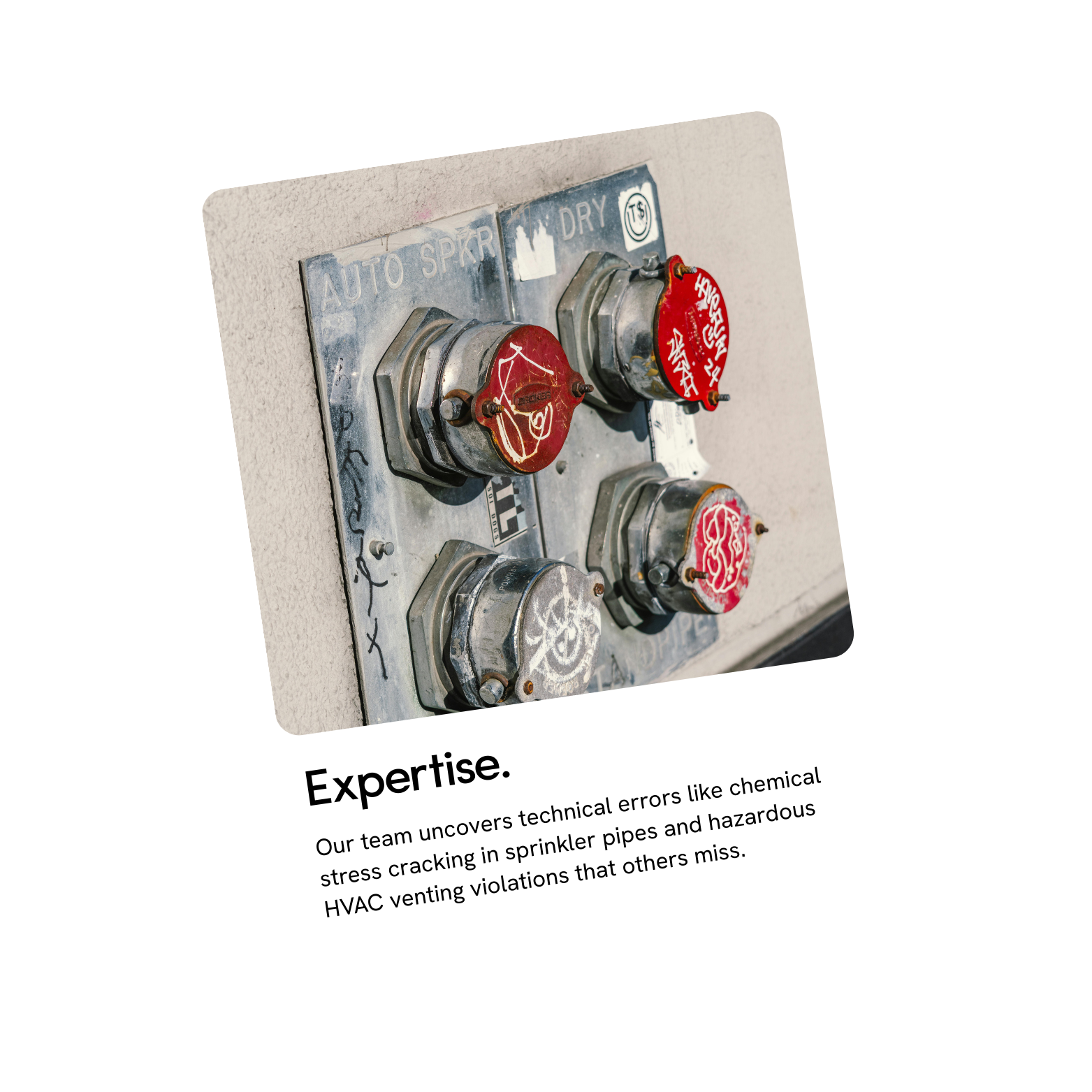
Fire sprinkler systems must be designed, installed, and tested to specific code requirements. Common defects include improper pipe sizing, incorrect sprinkler head selection, inadequate system pressure, leaking pipe joints, improperly installed hangers, and incorrect antifreeze concentrations in glycol systems. Even a small recurring leak from a sprinkler system in a relatively new building is a significant warning sign that requires immediate professional evaluation rather than routine maintenance patching.
Elevators.
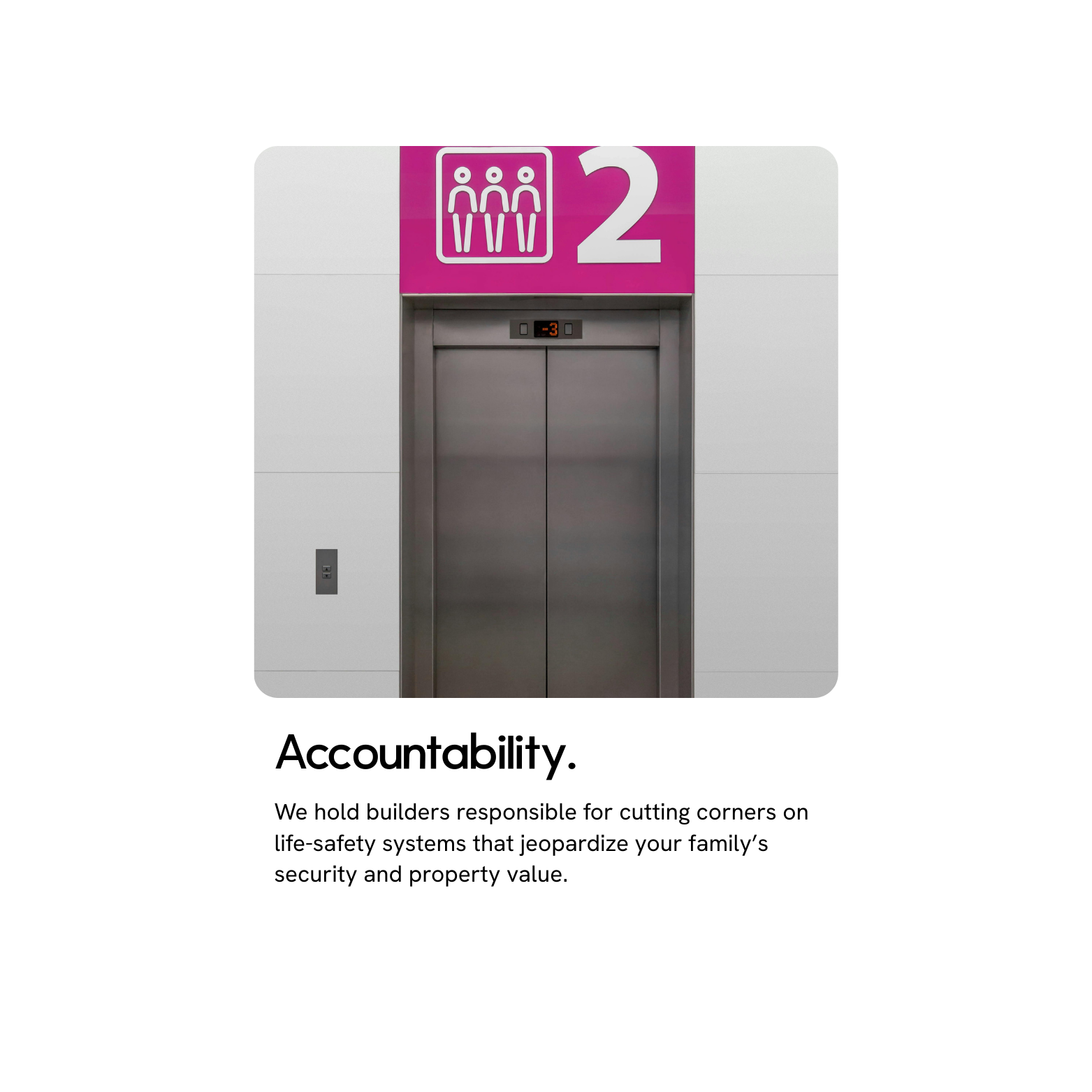
Elevator systems must be designed and installed to specific engineering and code requirements for the building's occupancy, height, and use patterns. Common defects include improper hydraulic system installation, inadequate machine room ventilation, incorrect counterweight sizing, improperly installed door safety systems, and control system programming errors. Frequent service calls for the same elevator in a relatively new building are not bad luck. They are a reliable indicator of a systemic installation defect that routine maintenance cannot resolve.
Snow Melt.
Snow melt systems must be designed specifically for local snowfall rates, temperatures, and paving surface types. Common defects include undersized boiler systems, improper loop spacing that produces patchy melting, incorrect glycol mixture ratios that allow freeze-up, improperly installed expansion joints, and control systems that do not activate at correct threshold temperatures. In communities where ice accumulation presents a fall hazard, a defectively installed snow melt system is both a construction defect claim and a premises liability risk.
HVAC.
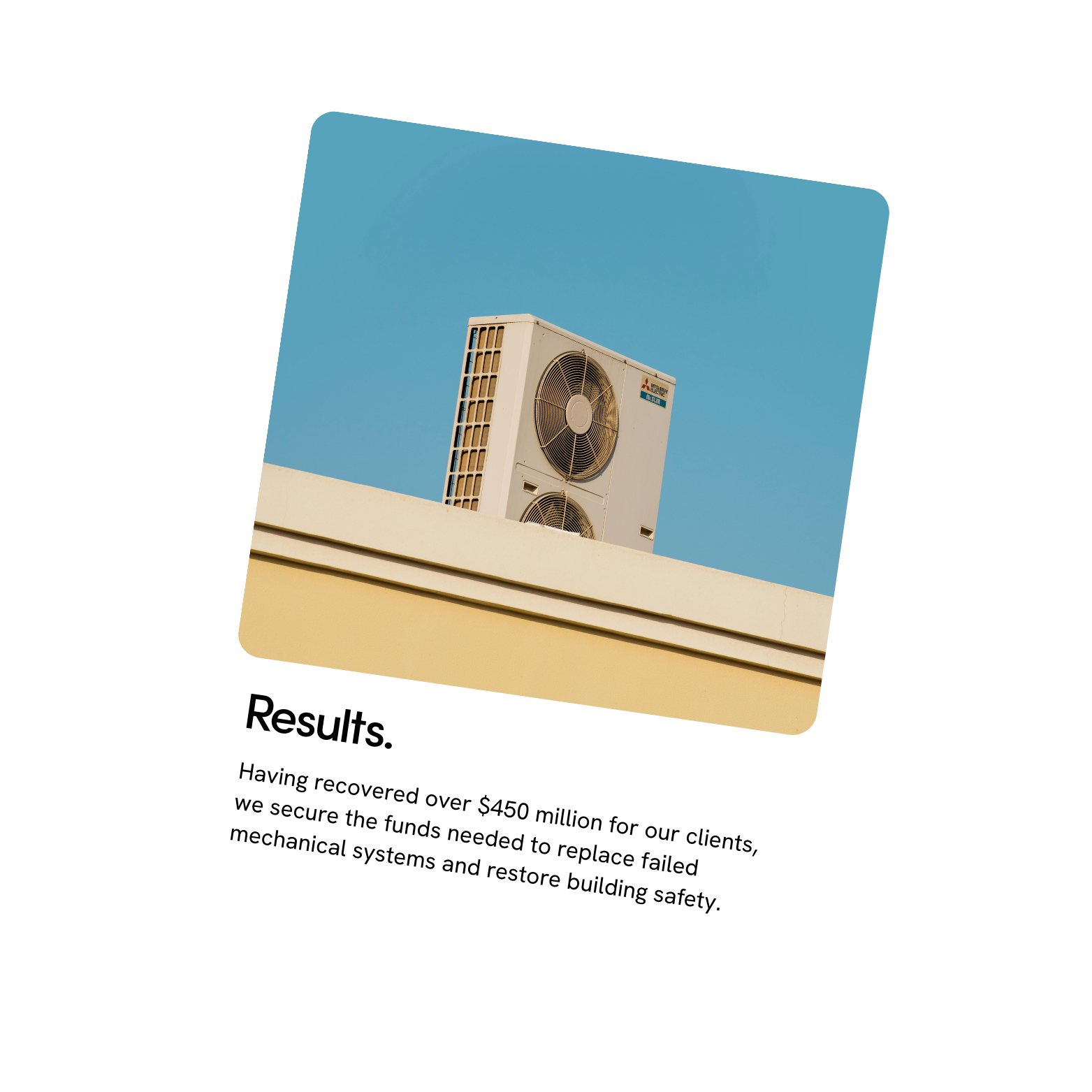
HVAC systems must be designed and installed to meet the specific heating and cooling loads of the building and Colorado's climate. Common defects include systems undersized for the building's demands, improper duct design creating significant temperature differentials between units, incorrectly installed fresh air ventilation, inadequate equipment access, and systems never properly commissioned before turnover. Persistent temperature complaints across multiple units in a new building are a strong indicator of a systemic design or installation defect rather than individual equipment failures.
Plumbing.
Heavy mechanical lines require specific hangers and bracing. Without them, pipes sag, create "bellies" that trap debris, or vibrate excessively, leading to joint failures.Common plumbing defects include improperly sloped drain lines causing recurring backups, undersized water supply lines that cannot meet peak demand, incorrect pipe material selection for Colorado's water chemistry, missing pressure reducing valves, and inadequate insulation on supply lines in exterior walls that causes freeze-up during Colorado winters. Plumbing defects are frequently dismissed as isolated incidents until a pattern across multiple units reveals the systemic nature of the installation failure.
Electrical.
Air conditioning units produce moisture that must be drained away. If these lines aren't pitched correctly or lack secondary "overflow" pans, water will leak directly into your ceiling and walls.Electrical construction defects include undersized service panels that cannot meet actual load demands, improper grounding and bonding creating shock hazards, incorrectly installed arc fault and ground fault circuit interrupters required by Colorado's building code, and improperly installed common area lighting and emergency systems. Electrical defects carry significant life-safety implications and are fully recoverable when they result from a builder's failure to follow the applicable electrical code requirements.
Frequently Asked Questions.
1
Cost
2
Time
3
Effort
4
Liability
-
A dry pipe system contains pressurized air rather than water under normal conditions, so any persistent dripping is a significant warning sign rather than a routine maintenance issue. The most common cause is residual water that was not completely drained after a previous activation or test, which then freezes and thaws repeatedly in Colorado's climate, accelerating internal pipe corrosion and joint failures. A leaking dry pipe system in a relatively new building should be evaluated by a construction defect attorney immediately because this symptom triggers Colorado's two-year statute of limitations.
-
Elevator service companies earn their revenue from ongoing maintenance contracts and call-back visits, which does not incentivize them to identify root-cause installation defects that would eliminate the need for continued service. When an elevator in a new building requires frequent calls for the same issues, the service company will typically continue repairing symptoms rather than identifying the underlying installation failure. Frequent call-back maintenance for the same elevator is a reliable signal of a systemic defect that warrants an independent forensic evaluation rather than continued reliance on the service contractor's assessment.
-
Patchy or inconsistent performance from a snow melt system is a strong indicator of a construction defect. Properly designed systems should deliver consistent performance across the entire treated surface, and sections that fail to activate indicate defects in the hydronic loop installation, boiler sizing, or control system design. In Colorado communities where icy walkways present a fall hazard, a defectively installed snow melt system is both a recoverable construction defect and a premises liability risk.
-
Persistent temperature complaints from multiple units in a relatively new building are a strong indicator of a systemic HVAC defect rather than individual equipment failures. A properly designed system should maintain consistent temperatures throughout the building under normal Colorado conditions, and widespread complaints point to undersized equipment, improper duct design, or incorrect zone balancing. Contact Hearn & Fleener before authorizing any major HVAC replacement, as the full replacement cost may be recoverable through a construction defect claim.
-
Immediately. Colorado's two-year statute of limitations begins running from the date a defect is discovered or reasonably should have been discovered, and for mechanical systems that date can be as early as the first documented service call or resident complaint. By the time the full scope of the defect becomes apparent, the filing window may have already closed. If your community has mechanical system symptoms in a building less than six years old, contact Hearn & Fleener today. A free evaluation costs nothing. A time-barred claim costs everything.

A Dripping Sprinkler or a Noisy Elevator Is Not Just a Maintenance Problem. It May Be Your Filing Deadline Starting.
Colorado's two-year statute of limitations for mechanical system construction defects can begin running from the first symptom your community reports. Do not let routine maintenance responses consume the time your community needs to protect its legal rights.
Contact Hearn & Fleener today for a free confidential evaluation of your fire suppression, HVAC, elevator, or snow melt system concerns. No upfront costs, no obligation, and no risk. You only pay us when you recover.