



At Hearn & Fleener, expansive soil construction defect claims are among our most significant and most impactful cases. We have recovered over $450 million for Colorado communities, and some of our largest individual recoveries have been for communities where builders ignored basic geotechnical requirements and left homeowners with heaving foundations, cracking slabs, bowed walls, and structural damage that compounds with every wet-dry cycle. We investigate the full scope of the soil-related damage, identify every responsible party, and build the legal case that forces builders to fund the comprehensive repairs your community deserves. Every step of our investigation is performed at no cost to your association or property.
Colorado Expansive Soil Construction Defect Attorneys.
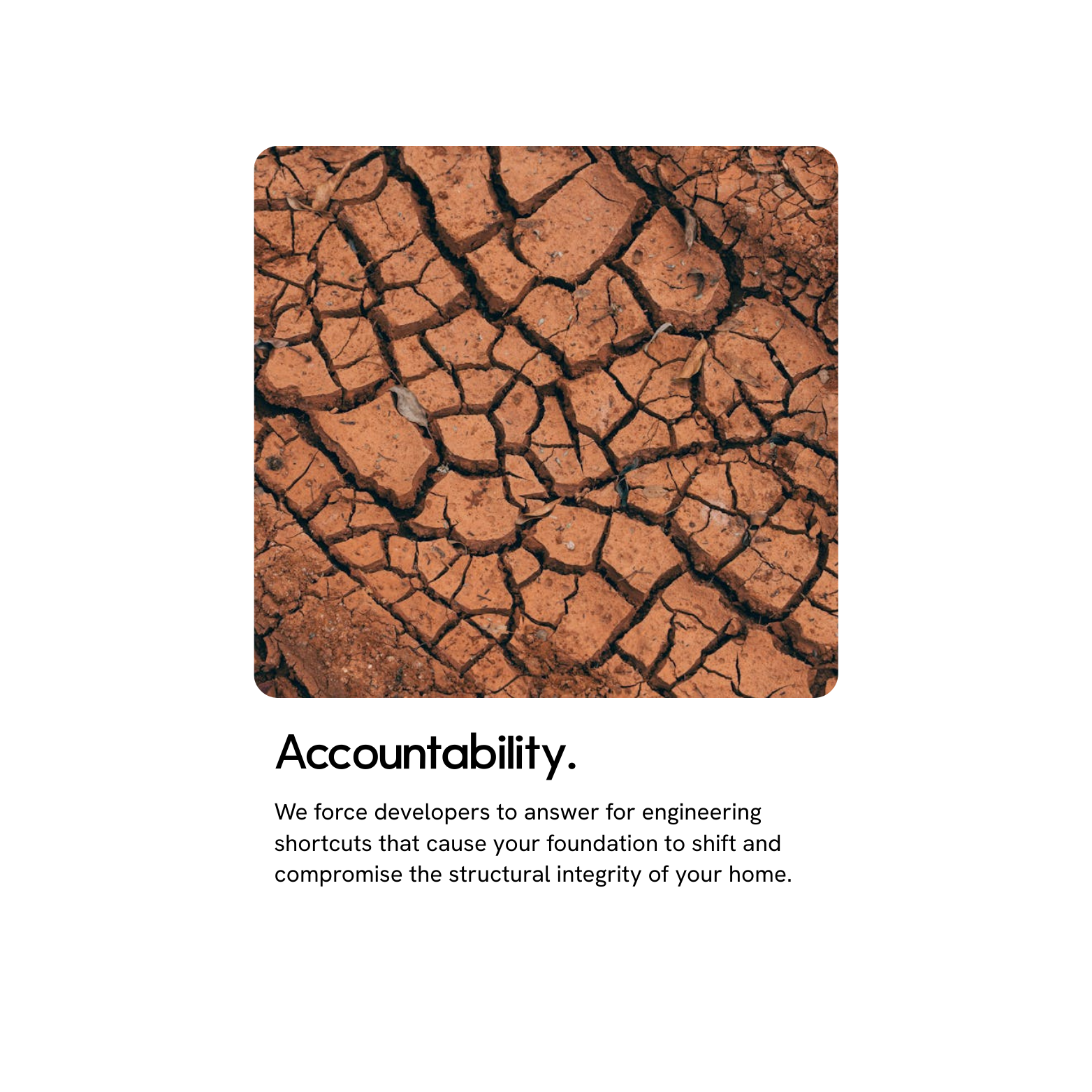


Colorado's bentonite clay soils are among the most destructive in the country. When builders ignore the geotechnical requirements designed to manage them, the consequences can affect every home in a community.
Expansive and swelling soils are the single most prevalent and most costly construction defect challenge in Colorado. The Front Range sits atop vast deposits of bentonite clay, a soil type that swells dramatically when it absorbs water and shrinks just as dramatically when it dries out. This constant movement exerts enormous pressure on every foundation, slab, and structure built above it. Builders who fail to follow the geotechnical engineer's site-specific recommendations to save time, to save money, or simply through carelessness, leave entire communities to absorb the cost of that failure for decades.

Why Colorado's Climate Makes Expansive Soil Defects So Destructive.
Colorado's Front Range has some of the most expansive clay soils in the United States. When builders ignore the geotechnical requirements designed to manage those conditions, the consequences compound with every season.
Here is why.



Bentonite Clay.
Colorado's Front Range sits on some of the most expansive soils in the country.
Drought.
Dry periods cause settlement that is equally destructive.
Wet-Dry Cycles.
Colorado's seasonal moisture swings keep the soil in constant motion.
Irrigation.
Landscape irrigation adds moisture that builders did not account for.
Snowmelt.
Slow spring snowmelt saturates soil adjacent to foundations.
Frost Depth.
Colorado's deep frost line amplifies foundation movement.
How Hearn & Fleener Investigates Expansive Soil Defects.
Expansive soil construction defect claims are among the most technically complex in Colorado law because the damage they cause is gradual, widespread, and easily attributed by builders to natural soil conditions rather than construction failures. Establishing that the damage results from a builder's specific failures to follow geotechnical requirements requires a forensic and legal investigation that combines soil science, structural engineering, and meticulous records research.
Here is exactly how we build that case.
-
Our team conducts a comprehensive inspection of the affected structures and building site, documenting foundation cracking patterns, slab heave and settlement, wall distortion, floor unlevelness, drywall cracking, sticking doors and windows, and grading conditions around the building perimeter. We photograph and measure every manifestation of soil-related damage across the property, creating a complete record of the damage that has occurred and the conditions that allowed it to develop.
-
We engage specialized geotechnical engineers to conduct independent soil testing at the affected properties. This testing determines the actual swell potential of the soil at the site, the depth to stable bedrock or non-expansive soil, and the moisture conditions present at various depths. This independent geotechnical data is compared directly to the original site-specific geotechnical report to establish what the builder was required to do and what was actually constructed.
-
The original geotechnical investigation report is one of the most important documents in any expansive soil construction defect claim. This report tells us exactly what the builder was told about the soil conditions at the site and exactly what engineering measures were required to build safely on those soils. We obtain the original geotechnical report, approved foundation plans, pier installation records, and building permits, and we compare what was specified to what was actually built. Every deviation from the geotechnical engineer's recommendations is a documented basis for legal liability.
-
Expansive soil repairs are among the most expensive in all of construction defect law. Underpinning with steel piers, excavating and rebuilding drainage systems, installing proper void spaces beneath slabs, and repairing the secondary damage caused by years of structural movement all contribute to repair costs that can reach tens of millions of dollars for large communities. Our forensic team develops a comprehensive repair scope and cost estimate that captures the full extent of the builder's liability, including both direct repair costs and the secondary damage caused by the soil movement.
-
Our complete findings, the structural inspection, geotechnical testing, records review, and repair cost development, are compiled into a written report and presented in person to your Board of Directors and management company. Your board receives a complete picture of every soil-related defect identified, the responsible parties, the projected repair scope and cost, and the realistic financial outcome of pursuing a claim. All of this is provided at no cost and with no obligation before your board makes any decision.
Common Soil Defects.
Expansive Soil & Foundation Deficiencies.
Foundation defects in Colorado are typically caused by a failure to follow geotechnical recommendations or the use of improper construction techniques.
Defect Types.
1
Grading
2
Depth
3
Reports
4
Drainage
Pier Depth.

Structural piers must be drilled through unstable expansive clay and anchored into stable bedrock below. When builders drill piers to inadequate depth to save time and cost, the piers remain in the zone of soil movement. As the clay swells and contracts with moisture changes, these shallow piers move with the soil rather than resisting it, causing the foundation and everything above it to heave and settle repeatedly throughout the year.
Void Spaces.
Structural floors in Colorado's expansive soil environment require a designed void space between the concrete and the soil that allows the soil to swell upward without pushing against the floor structure. The void depth is specified by the geotechnical engineer based on the measured swell potential at that specific site. When builders omit this void space or use a depth that does not match the geotechnical recommendation, expanding soil pushes directly against the floor slab, causing progressive buckling and cracking that compounds with every wet season.
Drainage.
Colorado building codes require site grading to slope away from the building perimeter, directing precipitation and snowmelt away from the foundation. When builders fail to establish proper drainage grades, water pools against the foundation and the expansive clay becomes and remains saturated for extended periods. This sustained moisture exposure triggers maximum swelling pressure against foundation walls and beneath slabs.
Floating Walls.
In Colorado basements, interior walls must be "floated" to allow the floor slab to move without pushing against the upper structure. Rigidly attached walls will cause the upstairs floors to heave and drywall to crack.Interior basement walls in Colorado must be constructed as floated walls, attached to the ceiling above but with a gap at the bottom that allows the floor slab to move independently. When builders attach interior walls rigidly to both the floor and ceiling, the heaving slab pushes the wall upward and into the floor structure above. The result is heaving floors, drywall cracking throughout the upper levels, and in severe cases, structural distortion of the load-bearing frame.
Soil Reports.
Every Colorado construction project on expansive soils requires a site-specific geotechnical report specifying exactly how the foundation must be designed for that location. When developers ignore these recommendations to save on excavation costs using shallower piers than specified or substituting a less expensive foundation system, they create a construction defect that manifests as progressive foundation damage across every home in the development. Ignoring a geotechnical engineer's recommendations is one of the clearest forms of builder negligence in Colorado construction defect law.
Window Wells.
Window wells collect rain and snowmelt if not properly drained. Building codes require a drain pipe at the bottom of each well connecting to the building's perimeter drain system. When builders omit this drain, the window well fills with water and saturates the soil directly against the foundation at its most vulnerable point. This localized saturation triggers concentrated swelling pressure at each window well location, causing cracking, bowing, and water infiltration into the basement.
Frequently Asked Questions.
1
Cost
2
Time
3
Effort
4
Liability
-
Normal settling occurs relatively uniformly in the first few years after construction. Expansive soil damage looks different, it is progressive, continues worsening with each wet and dry cycle, and produces specific patterns including diagonal cracking from door and window corners, unlevel floors, inward-bowing basement walls, slabs that heave upward, and sticking doors and windows. If these symptoms are continuing to worsen rather than stabilize, expansive soil construction failures are the most likely cause. Contact Hearn & Fleener for a free forensic evaluation.
-
Minor hairline shrinkage cracks in the first year or two are common and generally not a concern. However, large cracks, cracks where one side is higher than the other, cracks that continue to grow, or areas where the slab has heaved upward are signs of a systemic soil defect. These symptoms should be professionally evaluated rather than simply monitored, expansive soil damage compounds progressively and the cost of repair increases significantly the longer it goes unaddressed.
-
Most standard homeowner's insurance policies specifically exclude earth movement from coverage regardless of whether the movement results from natural causes or a builder's negligence. This exclusion makes pursuing a construction defect claim against the builder the primary mechanism for recovering the funds needed for expansive soil repairs in Colorado.
-
A French drain is a perforated pipe buried in gravel that intercepts groundwater and directs it away from the foundation before it can saturate the adjacent soil. In Colorado's expansive soil environment, controlling moisture adjacent to the foundation is critical. When builders omit French drains or install them incorrectly, the expansive clay receives far more moisture than the geotechnical design assumed, causing sustained soil swelling against the foundation that proper drainage would have substantially reduced.
-
Repairing an expansive soil-damaged foundation typically involves underpinning with steel piers drilled to stable soil, excavating to install proper drainage and void spaces, removing and replacing heaved slabs, and repairing the secondary damage caused by years of movement. These are major structural repairs that can cost many millions of dollars across an entire community. When they result from a builder's failure to follow the geotechnical engineer's recommendations, the builder and their insurance carriers are responsible for funding them through a Colorado construction defect claim.

Foundation damage from expansive soils is progressive by nature. Every wet-dry cycle that passes without a proper repair plan in place compounds the structural deterioration and increases the cost of the repairs your community will ultimately need. Colorado's construction defect filing deadlines are strict.
Contact Hearn & Fleener today for a free confidential forensic inspection and written report. No upfront costs, no obligation, and no risk. You only pay us when you recover.