


Colorado Structural Construction Defect Attorneys.
At Hearn & Fleener, we investigate the structural systems of your property with the same forensic depth we bring to every construction defect claim. We identify where builders cut corners, deviated from engineering specifications, or performed unauthorized field modifications that compromised the structural integrity of your building. Every step of our investigation is performed at no cost to your association or property.
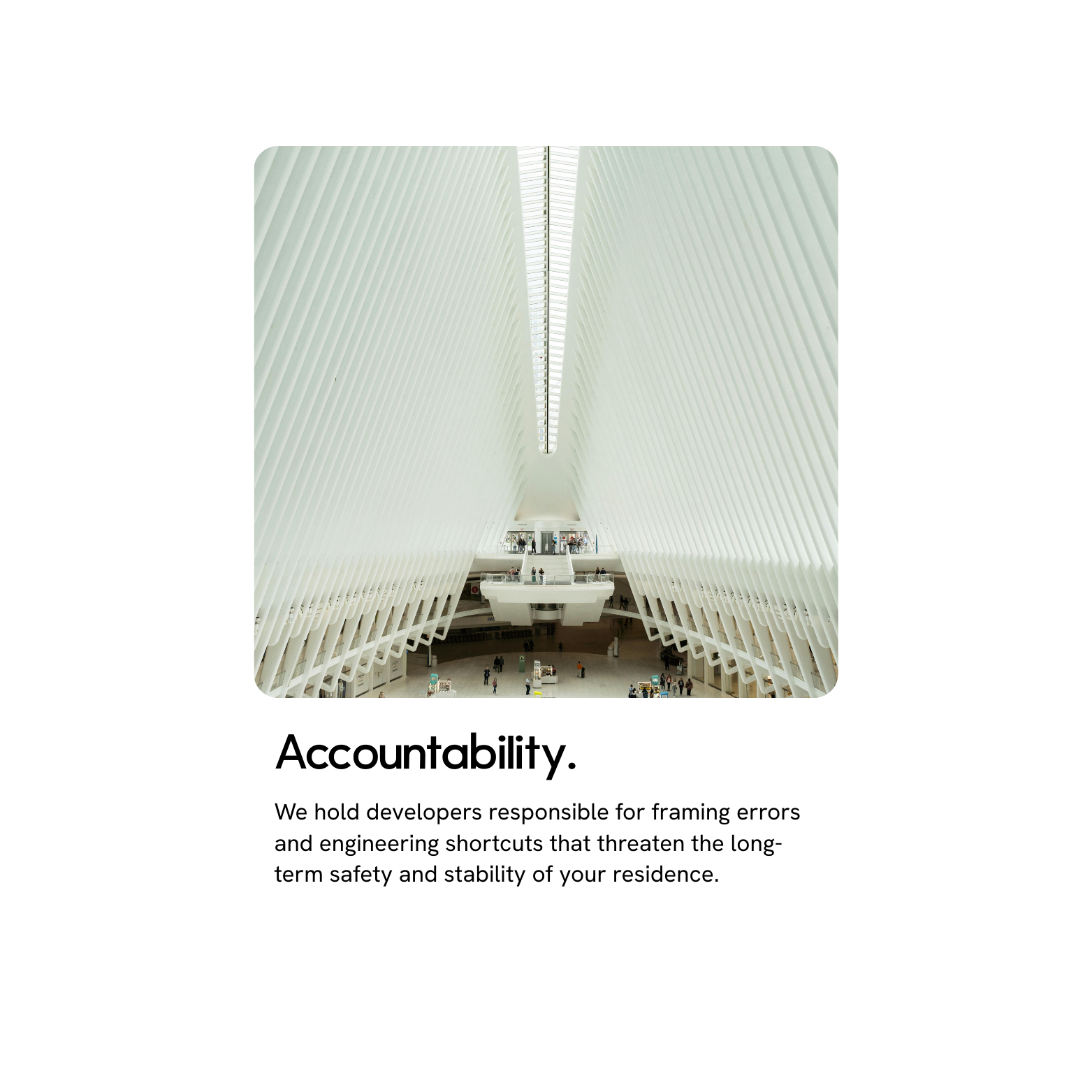



Structural defects are hidden behind the walls of your home. By the time they become visible, the damage is already serious. We find what builders tried to conceal and hold them accountable.
Structural defects involve failures in the essential components that hold a building together, the framing, load-bearing walls, roof trusses, beams, and connection hardware that carry every load from the roof to the foundation. Because these elements are hidden behind drywall, insulation, and finished surfaces, structural defects often go unnoticed for years until they manifest as sagging roofs, bouncing floors, diagonal wall cracks, or doors and windows that no longer close correctly.

Why Colorado's Climate Makes Structural Defects More Serious.
Colorado's climate places demands on structural framing systems that expose every weakness in a defectively built building. Here is why structural defects that might go unnoticed in a mild climate become serious and progressive failures in Colorado.
The why.


Snow Loads.
Heavy snow exposes every weakness in roof and floor framing.
Freeze-Thaw.
Temperature extremes stress framing connections repeatedly throughout the year.
Soil Movement.
Expansive soils transmit damaging forces through the entire structural frame.
UV & Altitude.
High altitude conditions accelerate degradation of exposed structural components.
Wind.
Special Wind Regions expose shear wall failures that calmer climates would not.
Moisture Cycling.
Colorado's wet-dry cycles accelerate wood rot in improperly protected framing.
How Hearn & Fleener Investigates Structural Defects.
Structural defect claims are among the most technically demanding in Colorado construction defect law because the evidence is hidden behind finished surfaces and the connection between a visible symptom and its structural cause requires engineering expertise to establish. Builders routinely attribute structural symptoms to normal settling, soil movement, or homeowner modifications rather than their own construction failures.
Here is exactly how we build the technical and legal case that holds them accountable.
-
Our team conducts a comprehensive inspection of the affected structures, systematically documenting every visible manifestation of structural deficiency including floor deflection measurements, drywall crack patterns, door and window operation failures, roof ridgeline profile, visible framing distortion, and any accessible connection hardware. Every finding is documented photographically and in written form, creating a complete symptom map across the property that our structural engineers use to identify the underlying structural failures responsible for each visible symptom.
-
Because structural defects are hidden behind finished surfaces, confirming the specific installation failures responsible for the visible symptoms requires opening walls, ceilings, or attic access at strategic locations. Our structural engineers direct selective invasive investigation at locations identified through symptom analysis to directly observe framing conditions, connection hardware, truss integrity, shear wall construction, and beam sizing. This direct observation of as-built conditions is compared to the approved structural plans to document every deviation.
-
We obtain the original building permits, approved structural engineering plans, and truss fabrication drawings for the affected buildings. These documents establish exactly what the builder was required to build and provide the direct comparison standard against which every field deviation becomes a documented deficiency. For structural defects involving special engineering requirements, such as shear wall design in Special Wind Regions or snow load engineering in mountain communities, we also review the applicable local building code amendments that the builder was required to follow.
-
Our structural engineering experts analyze the documented deficiencies and develop a comprehensive repair scope that addresses every structural failure identified during the investigation. Structural repairs frequently require removing finished surfaces to access framing, installing additional structural members, retrofitting connection hardware, and repairing or replacing modified trusses. The repair cost developed by our engineering team captures the full scope of the builder's liability, including both direct structural repair costs and the secondary damage to finishes and systems caused by the structural failures.
-
Our complete findings, the symptom mapping, invasive investigation results, structural plans review, code compliance analysis, and repair scope, are compiled into a written report and presented in person to your Board of Directors and management company. Your board receives a complete picture of every structural defect identified, the responsible parties, the projected repair scope and cost, and the realistic financial outcome of pursuing a claim. All of this is provided at no cost and with no obligation before your board makes any decision.
Common Structural Defects.
Structural Construction Deficiencies.
Most structural defects result from poor workmanship or unauthorized field changes that deviate from the original engineering plans. Because they are hidden behind finished surfaces, these defects are rarely discovered until they have been compounding for years. If your community or property is experiencing any of the following, you may have a valid Colorado construction defect claim.
Defect Types.
1
Concrete
2
Installation
3
Supports
4
Grading
Missing Connectors.

Metal hangers, straps, anchor bolts, and hold-down brackets are required by structural engineering plans and building codes to transfer loads between framing members and keep the building frame secure during high winds and heavy snow loads. When builders omit these connectors or substitute lighter hardware than specified to save cost, the framing connections rely entirely on nails and wood-to-wood bearing rather than the engineered hardware required. These deficiencies are invisible once drywall is installed but can be documented through invasive investigation and comparison to the approved structural plans.
Improper Modifications.
Roof trusses and engineered floor systems are precisely designed structural components that must not be cut, notched, or modified without engineering approval. When plumbing, HVAC, or electrical systems need to pass through a truss, installers frequently cut or notch the wood without consulting a structural engineer or obtaining approval. Each unauthorized cut removes material from a member that was designed with no additional margin. A single unauthorized truss cut can reduce that truss's load capacity significantly, and when multiple trusses in a roof system are similarly modified, the cumulative effect can threaten the structural integrity of the entire roof.
Wall Failures.
Every load in a building must travel a continuous path from its point of application downward through the structural frame to the foundation. When a heavy load from an upper floor is not properly tracked downward through solid blocking, transfer beams, or additional studs at bearing points, the framing members that are carrying loads they were not designed for can crush, buckle, or deflect. These load path failures are particularly common in multi-story construction where builders fail to align structural elements vertically or provide adequate bearing at critical transfer points.
Undersizing.
To save on material costs, developers may install beams that are insufficient for the weight they are meant to carry, leading to bouncy floors and sagging ceilings.Structural beams and floor joists must be sized by an engineer to carry the specific loads they will encounter based on the span, spacing, and loads above them. When builders substitute smaller members than specified in the approved structural plans to save on material costs, the undersized members deflect excessively under normal load. The result is floors that feel bouncy or soft underfoot, ceilings in the rooms below that visibly sag, and over time, progressive deflection that causes cracking in finishes throughout the building. Excessive floor deflection is one of the most commonly searched structural symptoms in Colorado construction defect cases.
Inadequate Supports.
Shear walls are reinforced sections of the building frame specifically designed to resist lateral forces from wind and seismic activity. They require precise nailing patterns, specific sheathing materials, and structural hold-down brackets at their ends to function as designed. When builders use incorrect nailing patterns, substitute thinner sheathing than specified, or omit the required hold-down hardware, the shear wall cannot resist the lateral loads it was designed for. The result is progressive racking of the building frame during high-wind events, visible as diagonal cracking throughout the building's drywall and doors and windows that no longer operate correctly.
Field Fixes.
When a framing member doesn't fit, workers often perform "field fixes" such as shimmying or sistering wood incorrectly. These unengineered solutions rarely meet code and can lead to localized structural failure.When a framing member does not fit as planned in the field, workers frequently perform unauthorized modifications, cutting members short and shimming the gap, incorrectly sistering additional wood to damaged members, or improvising connections with materials not specified in the plans. These unengineered field modifications rarely meet the applicable building code requirements and are almost never reviewed by the structural engineer of record. When discovered during forensic investigation, unengineered field modifications are among the most direct evidence of builder negligence because they demonstrate a deliberate departure from the approved structural plans.
Frequently Asked Questions.
1
Cost
2
Time
3
Effort
4
Liability
-
Bouncy or soft floors are among the most commonly searched structural symptoms in Colorado homes and are almost always a sign of undersized floor joists or missing bridging and blocking between joists. Floor joists must be sized by an engineer to limit deflection under normal residential loads. When builders use smaller joists than specified or omit the bridging that prevents joists from twisting, the floor system deflects excessively underfoot. In Colorado, heavy snow loads on upper-floor decks can accelerate this deflection significantly in an already-deficient framing system. Both undersized joists and missing bridging are recoverable construction defects under Colorado law.
-
Diagonal cracks warrant more concern than vertical or horizontal cracks. Small vertical hairline cracks can result from minor material shrinkage and are not necessarily alarming. Diagonal cracks that originate at the corners of door and window openings, however, are a strong indicator that the structural headers above those openings are undersized or improperly supported, or that the building frame is shifting due to shear wall failures or foundation movement. If diagonal cracking is appearing in multiple locations throughout your building, or if existing cracks are continuing to grow, contact Hearn & Fleener for a free forensic evaluation before attributing the pattern to normal settling.
-
A shear wall is a reinforced section of the building frame specifically engineered to resist lateral forces from wind and seismic activity. It consists of structural sheathing applied with a precise nailing pattern to a framed wall, with structural hold-down brackets at each end that anchor it to the foundation. When shear walls are built with incorrect nailing patterns, inadequate sheathing, or missing hold-down hardware, the building frame cannot resist lateral loads as designed.
The result is progressive racking of the structure during high-wind events, visible as diagonal drywall cracking, doors that no longer latch, and windows that stick or bind. In Colorado's Special Wind Regions, shear wall construction failures carry particularly serious consequences and are clearly recoverable construction defects.
-
In most cases, yes. Structural defects are typically corrected by adding new structural members alongside existing ones, installing required connection hardware that was omitted, retrofitting shear wall reinforcement, or replacing modified or damaged trusses. These repairs require removing finished surfaces such as drywall and ceiling materials to access the framing, which is why they are significantly more expensive than surface-level repairs.
The cost of structural repairs, including both the framing work and restoring all finishes is fully recoverable from the builder and their insurance carriers when the defects result from construction failures. Hearn & Fleener's forensic team develops a complete repair scope and cost estimate as part of our no-cost investigation process.
-
The simplest way to assess roof sagging from the exterior is to view the ridgeline from across the street. The ridgeline should be a straight, level line from end to end. If it appears to dip, curve, or sag at any point, the internal trusses or ridge beam supporting that section of the roof are likely failing or were never adequate for the span and load they were designed to carry. From the interior, a sagging roof often presents as visible bow in the ceiling surface below the affected area.
In Colorado, where heavy snow loads place significant weight on roof structures every winter, an already-compromised roof framing system can deflect progressively with each snow season. Contact Hearn & Fleener for a free forensic evaluation if your roofline shows any deviation from a straight and level profile.

Structural construction defects compound silently over time. Every Colorado winter's snow load, every wet-dry soil cycle, and every high-wind event places additional stress on a building frame that was not built correctly. Colorado's construction defect filing deadlines are strict.
Contact Hearn & Fleener today for a free confidential forensic inspection and written report. No upfront costs, no obligation, and no risk. You only pay us when you recover.